
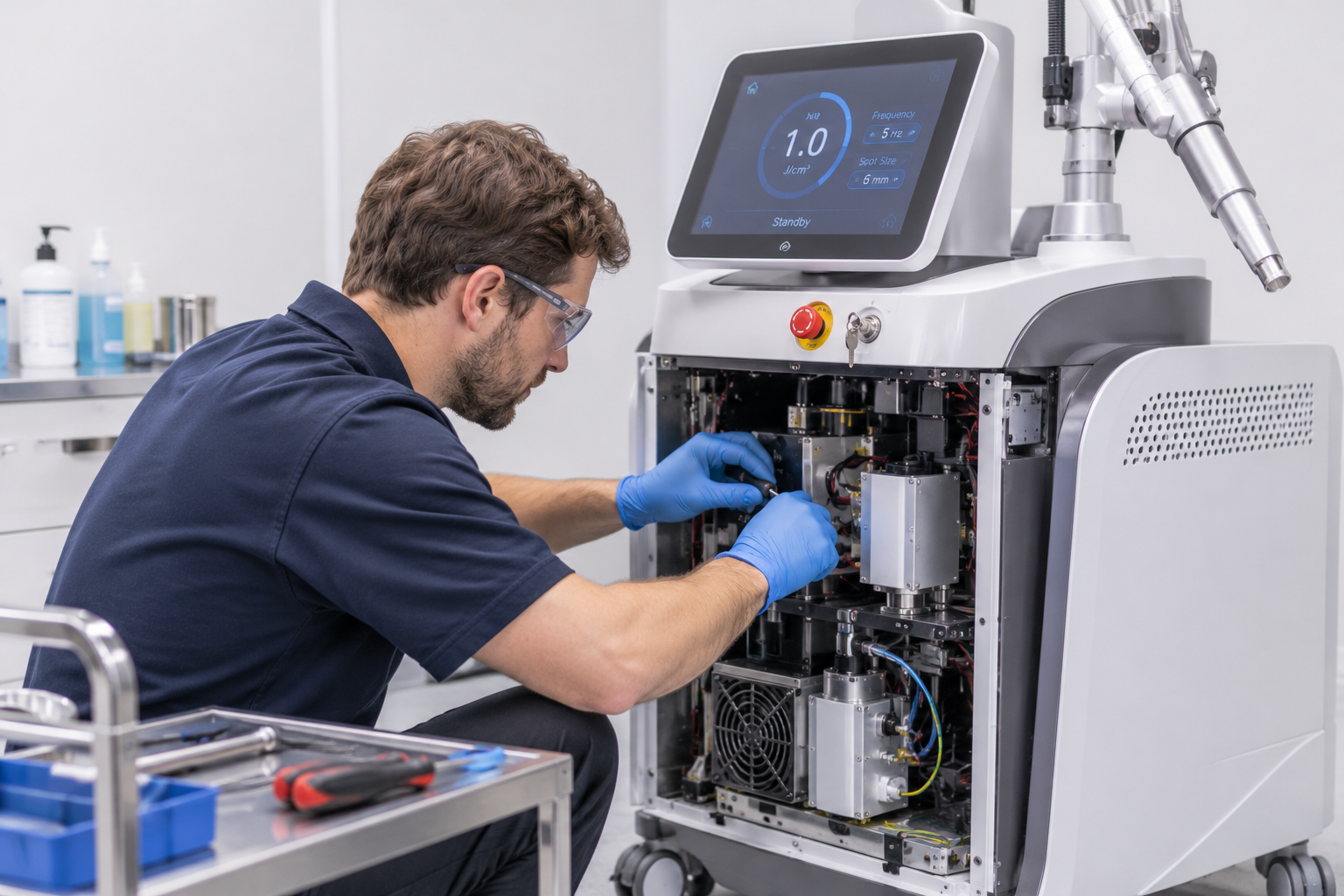
In a Picosecond Laser Tattoo Removal Machine, a laser is used to remove unwanted tattoos, and specific pigmented lesions. The performance of these devices will depend on laser energy, duration, wavelength, quality of optics and stable cooling. After extended periods of use, components have aged, contamination within the lasers can occur, or issues with cooling, leading to reduced laser energy, fluctuating laser energy, failure to fire and unexpected downtime. Therefore regular servicing and repairs will be required to maintain optimal performance. At APEX TECHNOLOGIES we offer support to troubleshoot, repair and service Picosecond Laser Tattoo Removal Machines. Below are frequently seen issues and repair, servicing requirements and how to select a professional service.
Uses of Picosecond Laser Tattoo Removal Machines
Picosecond Lasers are commonly used in aesthetic treatments to remove tattoos and pigmented lesions. Using ultra short pulses of laser energy, the pigments in tattoo can be fragmented into smaller particle sizes. The body will gradually clear these fragmented pigments.
Treatments performed include:
● Removal of multicoloured tattoos using multiple wavelengths.
● Treatments for pigmented lesions, where appropriate.
● Skin rejuvenation on compatible devices with fractional handpieces.
Common wavelengths used are 1064nm (black/dark blue pigments), 532nm (red/orange pigments) and 755/730nm (on compatible devices) for specific blue/green pigments. Results will depend on pigment make up, depth, skin type, wavelength and treatment settings. Usually multiple sessions are required.
Differences between Picosecond and Q-switched (Nanosecond) Lasers.
The main difference between these two technologies is the pulse length.
● Picosecond Laser – 10⁻¹² second pulse lengths. Produces strong mechanical effects on the pigments. Can be effective at removing difficult colours in tattoos, depending on the correct wavelength.
● Q-switched (Nanosecond) Laser – 10⁻⁹ second pulse lengths. Produces thermal and mechanical effects. Still widely used for removal of traditional tattoos.
Shorter pulse lengths do not necessarily produce better results, nor prevent side effects. An accurate assessment and correct device setup is still key.
Common Issues with Picosecond Laser Tattoo Removal Machines
Picosecond Laser Tattoo Removal Machines consist of laser, pump diode, crystal, power supply, cooling, handpieces and control boards.
Common issues include:
● Low laser energy – Caused by aged pump diode, contamination in optics, degraded crystal, or power supply issues.
● Laser failure to fire – May be due to faulty trigger, safety lock engaged, damaged cable or laser issue.
● Fluctuating energy – May be due to electrical issues, aged components, or temperature changes.
● Cooling error – May be due to incorrect flow/temperature of water in system. May be reduced water, clogged filters, failed pump or chiller.
● Handpiece issues – May be caused by damaged cables, loose connections and faulty internal components.
● Control error – May be frozen screen, error or incorrect function. May be due to control board or connection issues.
If any issues occur, stop using the device. Note error codes and contact a qualified technician.
Low power may be caused by:
● Aged Pump diode: As the laser ages and gets hot, the efficiency of the pump decreases.
● Contaminated optics: Particles in the optics may reduce the power.
● Degradation of crystal: From age, temperature changes and damage.
● Cooling problems: Poor water flow and fluctuating temperatures.
● Misalignment of optics: Vibration and poor maintenance may cause misalignment.
● Electrical issues: Malfunctioning power supply/sensors/cables/control boards may cause inconsistent outputs.
It is very important to correctly identify the problem in order to fix it, as different problems may cause similar symptoms. If parts are replaced incorrectly, this may increase costs.
Repair Process
To repair a Picosecond Laser Tattoo Removal Machine, the following steps are generally taken:
● Initial Information: Machine model/serial number, error codes, nature of issue, history of device in use, and images/videos.
● Technical Check: Check laser, pump diode, crystal, optics, power supply, cooling, handpieces, cabling and control board.
● Repairs: Depending on the issue identified, cleaning of optics, electrical repairs, maintenance of cooling, adjustment of components or replacement of faulty components may be required.
● Calibration and Testing: Check laser settings. Ensure device has stable power output, stable cooling, functional handpiece and safe functions, as per manufacturers guidelines.
● Repair Summary: Summary of issue(s), works carried out, components replaced, test results and maintenance advice.
Time and Cost
Time to repair will depend on type of issue, machine model, and availability of components.
● Simple issues/troubleshooting: 1-2 working days
● Pump module or electrical repairs: 3-5 working days
● Crystal / major optic repairs: 7-10 working days
This information is a guide only.
Costs may include diagnosis, component costs, labour, calibration and testing. For clarity on the costs of repair, please ask for a breakdown. If the main laser system is still in good condition, it may be economical to repair. If key components are discontinued, or cost of repairs is comparable to purchasing a new machine, it may be more practical to replace.
Acceptance and Testing
Even if the machine switches on, it may not be fully repaired.
Important tests to be carried out include: Stable laser power, correct pulse duration (as per manufacturers information), good beam quality, correct optics alignment, stable cooling, handpiece firing, emergency stop, safety locks and alarms and appropriate running.
Acceptance criteria should be in line with manufacturers information and the type of repair. Ask for test results and written warranty information.
Routine Maintenance
Daily routine maintenance includes inspection of equipment, handpieces, warning signals, cooling system, cables, abnormal sounds/vibrations. Monthly maintenance includes checking water volume/flow, filters, cooling system, connections and historical performance.
Qualified technicians should check optics, lasers, cooling systems, electrical connections and safety systems. Frequency of service will depend on how frequently it is used, treatment volumes, environmental conditions, and manufacturers guidelines.
Selecting a Reliable Service
Technicians should have experience with aesthetic and picosecond laser devices. Technicians should be able to identify faults with lasers and optics, service pump diodes, crystals and cooling systems, calibrate and test, and also be clear on pricing, parts replaced, warranty details and technical support.
Do not select simply based on cost. A thorough diagnostic and testing of the device will ensure that it performs reliably and safely in the long term.
APEX TECHNOLOGIES: Picosecond Laser Tattoo Removal Machine Repairs
If you are experiencing issues with your Picosecond Laser Tattoo Removal Machine we can help you. We can help with low power, unstable output, no firing, pump diode issues, crystal damage, optical issues, cooling error messages, faulty handpiece, or electrical issues. Depending on what model of machine that you have and what issues you are facing we may be able to help remotely, with component testing, component repairs/replacements, calibrations and post repair tests.
Professional support for Picosecond Laser Tattoo Removal Machine Repairs. Please provide model, serial number, issue type, error messages and photos/videos. Our technicians can then give you an initial diagnosis, advise on the best course of action and provide you with a quotation so you can get your device working efficiently with minimal downtime.