
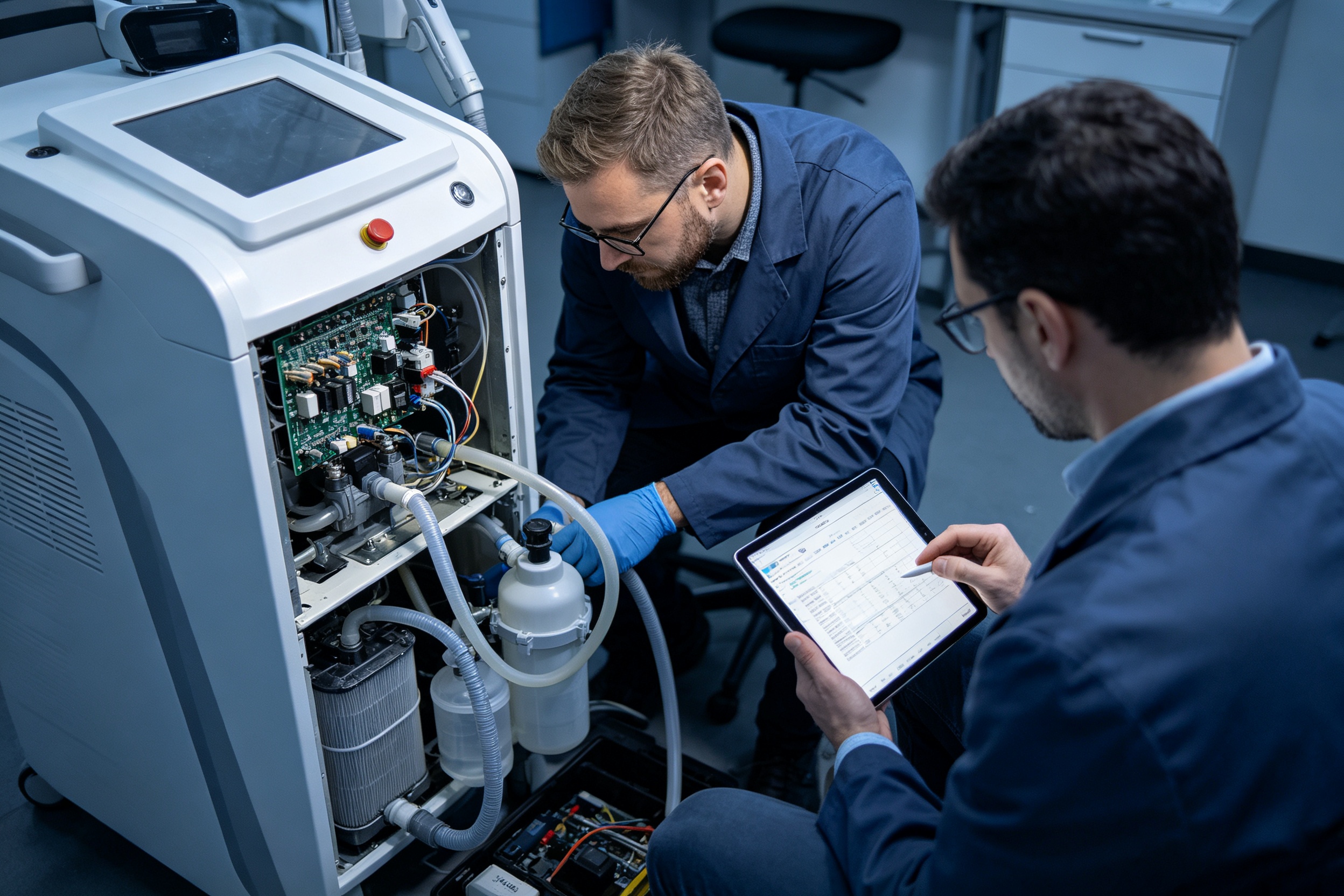
When a diode laser stops working, the first reaction is often simple: replace the handpiece, replace the power supply, or replace the machine.
In practice, it is rarely that simple.
A diode laser system is made up of several parts that depend on each other. The handpiece, laser module, driver, power supply, cooling circuit, sensors and control board all have to work together. A fault in one component can sometimes look like a problem with another.
That is why, in our experience, the right spare part is not necessarily the first part you suspect.
For distributors and repair technicians, this distinction can save both time and money.
The Handpiece Is Often Where Problems Become Visible
The handpiece is the component in the equipment that experiences the most frequent physical wear. During the treatment process, it is repeatedly moved, exposed to high temperatures, and frequently plugged and unplugged; for the water-cooling system, its normal operation also depends on the effective circulation of the coolant.
As the usage time progresses, various problems may arise, such as a decrease in output power, a deterioration in cooling effect, leakage, cable damage, communication failures, or complete failure of the handpiece.
However, replacing the entire handpiece is not the only solution.
Depending on the specific construction of the equipment, the maintenance work may involve diode stacks, cooling components, connectors, cables, optical elements, or other internal components. Professional laser equipment repair companies usually regard the handpiece as a repairable component rather than directly replacing the entire unit.
Therefore, it is of utmost importance to accurately identify the specific faulty components.
Cooling Problems Deserve More Attention Than They Usually Get
A diode laser can have a perfectly good laser module and still fail because the cooling system is not working correctly.
A weak pump, restricted water flow, damaged tubing, dirty filter, faulty flow sensor or temperature sensor can cause the machine to generate an alarm or stop operation.
This creates a common troubleshooting mistake: seeing a cooling error and immediately replacing the cooling unit.
A better approach is to check the cooling circuit step by step.
Is the coolant circulating?
Is the flow sensor responding?
Is the pump operating normally?
Is there a leak or blockage?
Is the temperature reading reasonable?
Only after these questions are answered should the technician decide which component needs to be replaced.
Cooling-system inspection and maintenance are also a standard part of professional aesthetic laser servicing.
A Power Supply Problem May Not Be a Laser Problem
Another common situation is that the machine fails to start, shuts down unexpectedly, or has unstable output.
Although the problem may seem to be with the laser module, the real cause might lie in the power supply, driver board, wiring, connectors, or control system.
This is especially important when working with replacement power supplies. Two units may have similar dimensions and connectors while having different output characteristics.
For that reason, we do not recommend selecting a power supply simply from a photograph.
The original model, voltage, current, power rating, connector configuration and machine model should be checked before ordering.
The Same Machine Model Does Not Always Mean the Same Part
This is something buyers often discover only after receiving an incompatible component.
A machine may have different versions during its production life. A later version may use a different PCB, connector, handpiece, power supply or cooling configuration.
Even components that look identical can have different electrical specifications.
When sourcing a diode laser spare part, the most useful information is usually the machine model + original part number + component label + clear photographs.
A photograph of the connector or the installation position can sometimes be more useful than a photograph of the whole machine.
Repair or Replacement?
There is no standard answer to this.
If cables, connectors, sensors, seals or other small components malfunction, replacing that specific component might be a reasonable approach.
If a handpiece has a damaged internal diode stack or cooling component, repair may be worth considering before purchasing a new handpiece.
On the other hand, if a component has extensive damage or the repair cost approaches the cost of a tested replacement, replacement may be the more practical option.
The decision should be based on the actual condition of the component, availability of parts, repair cost and expected service life—not simply on the age of the machine.
For clinics and distributors, there is another factor: downtime.
A cheaper repair is not necessarily cheaper if the machine remains unavailable for weeks waiting for a difficult-to-source component.
What We Look for Before Supplying a Spare Part
At APEX TECHNOLOGIES, we approach spare-parts sourcing from the repair side rather than simply matching product names.
When customers contact us, we would like to know which machine is being repaired and what exactly has happened.
A useful request normally includes the machine model, photographs of the original part, part number if available, connector details, and a short description of the fault.
For example, “the handpiece does not work” gives us very little information.
“808nm diode laser, handpiece suddenly stopped firing, cooling still works, display shows an error, and the connector looks normal” gives a much better starting point.
The goal is not to sell the biggest replacement part. The goal is to identify the most reasonable repair path.
Spare Parts Are Part of the Machine’s Service Life
Beauty equipment will not necessarily be scrapped due to a malfunction of a single component.
As long as the diagnosis is accurate, the maintenance is proper, and there are suitable replacement parts available, many devices can continue to operate for a long time even after the original warranty period has expired.
This is particularly important for distributors and service companies supporting older equipment. Keeping access to handpiece components, cooling parts, power supplies, driver boards, sensors, cables and other commonly required components can make repairs considerably easier.
The real value of a spare-parts supplier is therefore not simply having a long product list.
It is being able to help answer a more practical question:
“What actually needs to be replaced?”
APEX TECHNOLOGIES — Parts With a Repair Mindset
APEX TECHNOLOGIES supplies diode laser spare parts, aesthetic machine components and repair-related products for distributors, service companies, technicians and professional equipment users.
We work with customers who may already know exactly what part they need, as well as customers who only know that their machine has stopped working.
If you are not sure which component has failed, send us the machine model, photos of the part, available part number and a brief description of the problem.
We will evaluate the information and help you identify a suitable replacement solution.
Because when a diode laser goes down, the important question is not simply “Where can I buy a part?”
It is: “Which part actually needs to be replaced?”